


As AI builders push GPU {hardware} to its limits, researchers from CertiK and Columbia College are exploring a approach to mathematically confirm that the software program operating these methods produces appropriate outcomes.
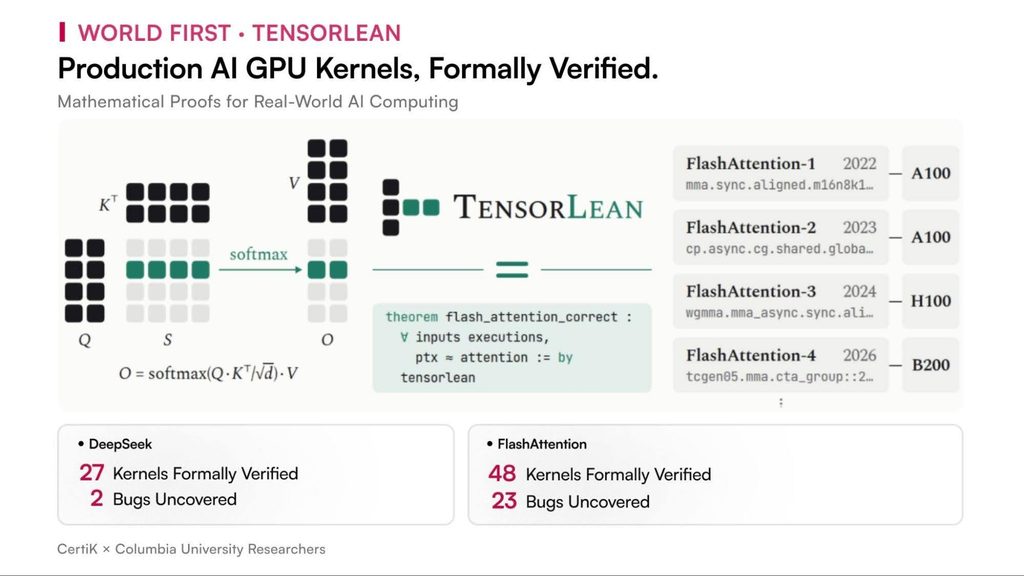
Their new framework, TensorLean, introduced November 20, applies formal verification to manufacturing GPU kernels, utilizing machine-checkable proofs developed in Lean. The researchers say the method marks the primary formal verification of manufacturing AI kernels and will assist handle a persistent problem in AI infrastructure: making certain that efficiency optimizations don’t introduce computational errors.
The group examined TensorLean on greater than 100 manufacturing GPU kernels throughout a number of generations of GPU architectures, together with code from DeepSeek and the FlashAttention library. The analysis uncovered 25 bugs, comprising two in DeepSeek kernels and 23 in FlashAttention.
Why AI Kernels Want Mathematical Verification
GPU kernels carry out the low-level mathematical operations that underpin AI mannequin coaching and inference. As builders optimize these packages to enhance efficiency and cut back computing prices, their implementations turn into more and more complicated.
Standard testing can determine issues in particular examples, but it surely can’t set up {that a} program meets its necessities throughout all inputs and execution situations inside its supposed scope. Formal verification addresses this limitation by utilizing mathematical proofs to ascertain that code satisfies outlined specs.

For manufacturing GPU kernels, that is difficult by the necessity to account for real-world execution conduct. Packages could overlap information transfers with computation, change execution configurations relying on workload dimension, and depend on lower-precision arithmetic to enhance effectivity.
TensorLean incorporates these situations into its verification course of. It examines PTX code immediately, permitting researchers to confirm the computations generated by means of NVIDIA’s GPU compilation pipeline reasonably than relying solely on higher-level program representations.
The proofs are developed in Lean, which checks the mathematical logic and produces machine-checkable proof that the verified computations meet their necessities inside outlined numerical tolerances.
Protecting Verification As much as Date With AI Improvement
One of many framework’s supposed functions helps builders preserve correctness as they proceed optimizing their GPU code. Every time an implementation adjustments, groups can rerun verification to find out whether or not the up to date model nonetheless meets its necessities.
The method additionally permits researchers to reuse current specs for associated mathematical operations, doubtlessly decreasing the trouble concerned in extending verification to further kernels.
Ronghui Gu, co-founder of CertiK and a pc science professor at Columbia College, stated the aim is to make sure that efficiency enhancements are accompanied by dependable proof of correctness, decreasing the opportunity of errors reaching large-scale AI coaching and deployment.
The monetary implications will be important. The researchers provided a hypothetical instance wherein a $100 million coaching run requires 1% of its computation to be repeated due to a kernel error, leading to an extra $1 million in computing prices.
TensorLean additionally arrives amid broader curiosity in making use of mathematical proofs to software program reliability. In October, Anthropic revealed analysis on utilizing Claude to assemble mathematical proofs for open-source software program. Whereas that work centered on basic software program, TensorLean applies formal verification to the underlying computational infrastructure utilized by AI fashions.
The researchers’ findings counsel that formal verification may turn into an vital a part of AI infrastructure improvement, notably as more and more subtle optimization strategies make it tougher to ascertain the correctness of manufacturing code by means of standard testing alone.
Disclaimer
In keeping with the Trust Project guidelines, please be aware that the knowledge offered on this web page just isn’t supposed to be and shouldn’t be interpreted as authorized, tax, funding, monetary, or some other type of recommendation. You will need to solely make investments what you possibly can afford to lose and to hunt impartial monetary recommendation you probably have any doubts. For additional info, we recommend referring to the phrases and situations in addition to the assistance and help pages offered by the issuer or advertiser. MetaversePost is dedicated to correct, unbiased reporting, however market situations are topic to alter with out discover.
About The Creator
Anastasiia O. is an editor at MPost, the place she focuses on reshaping content material throughout a large spectrum of matters. With a watch for element and a real curiosity in storytelling, she helps be certain that the content material is each correct and interesting. Her expertise spans a number of areas, offering her with the information to supply insightful contributions to varied matters highlighted on the platform.

Anastasiia O. is an editor at MPost, the place she focuses on reshaping content material throughout a large spectrum of matters. With a watch for element and a real curiosity in storytelling, she helps be certain that the content material is each correct and interesting. Her expertise spans a number of areas, offering her with the information to supply insightful contributions to varied matters highlighted on the platform.
You might also like


More from Metaverse Global


Kitely rebuilds its OpenSim code with teams of AI agents – Hypergrid Business
Eighty bots on the Kitely Welcome Heart. (Picture courtesy Kitely.)Kitely, the cloud-based OpenSim grid recognized for its on-demand areas, …